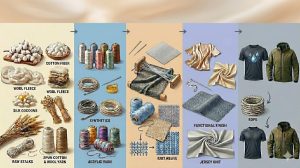
In textile sourcing and apparel manufacturing, understanding the functional differences between polyester and spandex is essential for selecting the right fabric structure.
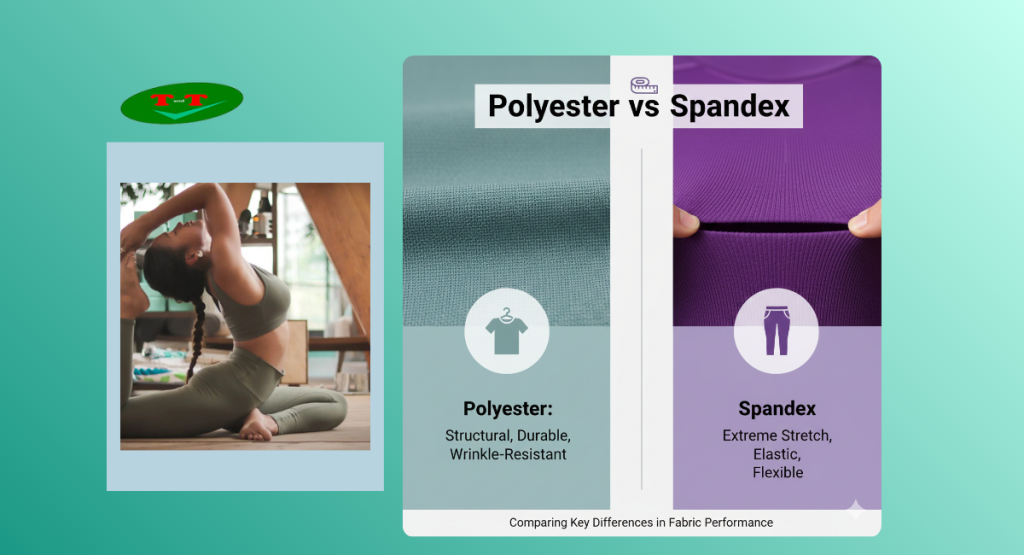
- Polyester is widely valued for its durability, dimensional stability, ease of care, and cost efficiency, making it an ideal base fiber for a broad range of garments.
- Spandex (also known as elastane), a polyurethane-based fiber, is defined by its exceptional elasticity—capable of stretching up to 500–600% and recovering its original shape. This unique property enables close-fitting silhouettes, enhanced comfort, and unrestricted movement.
In modern apparel, these two fibers are rarely used in isolation. Instead, polyester–spandex blends have become the industry standard, combining structural strength, moisture management, and long-term durability with stretch and fit adaptability. This synergy is widely applied across product categories ranging from sleepwear to high-performance activewear.
Polyester vs Spandex: Key Differences at a Glance
| Feature | Polyester | Spandex |
| Stretch | Low (unless blended) | Extremely high |
| Primary Function | Structural base fiber | Elastic functional fiber |
| Durability | Excellent, abrasion-resistant | Sensitive to heat and chemicals |
| Care & Maintenance | Easy care, wrinkle-resistant | Requires gentle washing, low heat |
| Moisture Management | Good moisture-wicking, quick-drying | No inherent moisture-wicking |
| Cost | Generally lower | Higher per unit |
| Typical Usage | Woven & knit base fabrics | Added in small percentages (2–10%) |
Key Performance Differences Explained
- Stretch and Flexibility: The most fundamental difference between polyester and spandex is elasticity. Spandex is engineered for extreme stretch and recovery, making it essential for garments that require body-hugging fit and freedom of movement, such as leggings, swimwear, and performance sportswear. Polyester, by contrast, has limited natural stretch and maintains its shape well. When blended with spandex, polyester fabrics gain controlled elasticity without compromising structural integrity.
- Durability and Care Requirements: Polyester is highly resistant to wrinkling, shrinking, and fading, and it tolerates frequent laundering with minimal performance loss. Spandex, while durable in use, is sensitive to high heat, aggressive detergents, and chlorine, which can degrade its elastic properties over time. Polyester–spandex blends balance these characteristics, delivering long garment life when cared for properly—typically cold washing and low-heat drying.
- Moisture Management and Comfort: Polyester plays the dominant role in moisture control. Its hydrophobic nature allows sweat to be transported away from the skin and evaporated quickly, supporting thermal comfort. Spandex contributes fit and stretch but does not provide moisture-wicking on its own. This division of roles explains why polyester–spandex blends dominate activewear and athleisure markets.
Choosing the Right Fabric Strategy
- For structure, durability, and easy maintenance: Polyester is the preferred choice for basics, sleepwear, and garments requiring long service life.
- For flexibility, fit, and performance comfort: Polyester–spandex blends offer an optimal balance. Most applications require only 2–10% spandex to significantly enhance comfort and mobility without increasing cost or care complexity.
Conclusion
Polyester and spandex serve fundamentally different but complementary roles in textile engineering. Polyester provides the backbone—strength, stability, and moisture management—while spandex delivers controlled elasticity and fit precision. Understanding how and when to combine these fibers allows brands and manufacturers to design fabrics that meet both performance expectations and cost targets.
In real-world fabric engineering, polyester and spandex rarely function as standalone fibers. Their performance is most effectively realized when they are structurally combined through covered yarn construction, where spandex serves as the elastic core and polyester acts as the protective outer layer.
Tani Thread specializes in covered yarn solutions designed for the U.S. apparel market, supplying elastic yarns that meet specific requirements for stretch performance, uniformity, and production compatibility across activewear, underwear, and performance-driven applications.
For customized covered yarn developed to match your fabric structure and end-use demands, contact Tani Thread to discuss your sourcing needs.
TANI THREAD CO., LTD
- Address: Thanh Hoa Hamlet, Thanh Dien Commune, Chau Thanh District, Tay Ninh Province, Vietnam
- Hotline: 0984.841.239
- Email: sale@tanithread.com
- Website: tanithread.com
- Fanpage: Tani Thread