Textile materials are the foundation of every textile product, directly influencing performance, durability, and end-use applications. But what exactly are textile materials, and how do different types impact manufacturing outcomes? From natural and synthetic fibers to emerging bio-based innovations, understanding textile materials is essential for making informed sourcing decisions.
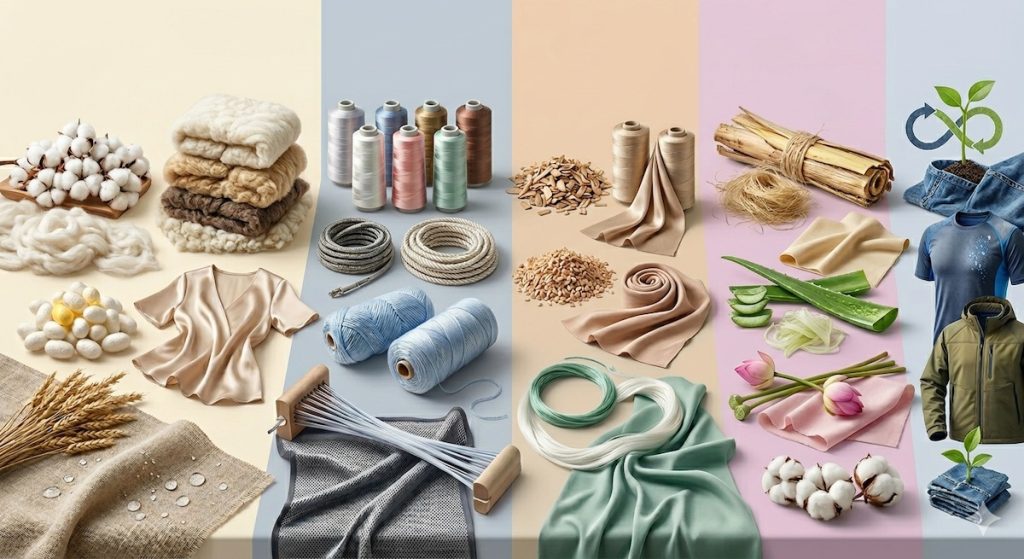
This guide explores key material categories, their properties, and the latest trends shaping the industry in 2026.
What Are Textile Materials?
Definition of Textile Materials
Textile materials are broadly defined as raw fibers, which serve as the fundamental units for creating all types of fabrics.
From a material science perspective, textiles represent a hierarchical material system: the process begins with small precursors (fibers) that are spun into continuous lengths of yarn, which are then woven, knitted, or bonded to form a complete fabric structure. The inherent characteristics of the chosen fibers largely determine the end product’s essential properties, such as weight, drape, breathability and durability.
Based on their biological origin and manufacturing processes, textile materials are classified into three primary categories:
- Natural fibers
- Synthetic fibers
- Semi-synthetic fibers
The strategic combination of these fibers through blending or advanced covered yarn technology allows manufacturers to create innovative materials that optimize both the comfort of natural fibers and the high-performance efficiency of synthetics.
The Role of Materials in Textile Production
In modern textile manufacturing, materials—particularly fibers—are the fundamental units that determine the performance, functionality, and value of the final product. They serve as a bridge between design intent and practical application, balancing technical performance, cost efficiency, and sustainability.
- Technical Performance and Engineering Properties: The selection of a specific fiber is the primary determinant of a fabric’s technical behavior, including its weight, drape, tenacity, and breathability. For example, synthetic fibers like polyester are often designed for moisture-wicking capabilities in athletic wear, while others are developed to function as protective outer shells against harsh weather conditions.
- Aesthetic and Comfort Characteristics: Beyond pure functionality, materials define the aesthetic “soul” and tactile hand of a garment. Natural fibers offer unique sensory profiles that are difficult to replicate; silk, for instance, achieves its signature luxury and luster through a triangular prism-like molecular structure that refracts light,,. Similarly, the inherent crimp of wool provides natural thermal regulation and elasticity, ensuring comfort across varying climates.
- Optimization through Fiber Blending: Textile performance is frequently optimized through the strategic synergy of fiber blending, which merges the best attributes of different materials to compensate for individual weaknesses. A common industrial application is the cotton-polyester blend, which combines the breathability of natural cellulose with the wrinkle resistance and durability of synthetics.
- Sustainability and Environmental Impact: Material choice has become the central factor in determining a brand’s ecological footprint and life-cycle impact. The industry is increasingly contrasting petroleum-based synthetics, which contribute to microplastic pollution, with biodegradable natural fibers that offer a lower carbon footprint.
- Advanced and Industrial Applications: The role of textile materials now extends far beyond traditional apparel into high-performance industrial and medical sectors. In medicine, specialized fibers are utilized as scaffolds for tissue engineering and surgical meshes due to their biocompatibility and mechanical stability. In high-tech fields, aramid fibers like Kevlar provide essential ballistics protection through their extreme tensile strength, while carbon fiber weaves have become indispensable for aerospace components and advanced sporting goods.
Types of Textile Materials
Natural Textile Materials
Natural textile materials are broadly classified by their biological origin as either cellulosic (plant-based) or protein (animal-based) fibers. Unlike synthetics, these fibers are formed through biological processes and are valued for their breathability, biocompatibility, and potential for biodegradability.
Cotton
Often referred to as the “king of fibers”, cotton is a staple cellulosic fiber harvested from the seed pod of the cotton plant.
It is the most widely consumed natural fiber globally due to its exceptional softness, breathability and hypoallergenic properties. A unique technical characteristic of cotton is its increased tenacity when wet, becoming approximately 25% stronger, which enhances its launderability.
Wool
Wool is a protein fiber sourced primarily from sheep, though luxury variants include cashmere from goats and fleece from alpacas.
Its performance is driven by a unique physical structure featuring natural “crimps” and microscopic scales that provide excellent elasticity and thermal regulation. Technically, wool is a superior moisture manager; it can absorb up to 30% of its weight in water without feeling damp to the wearer.
Furthermore, the absorption process is slightly exothermic, releasing small amounts of heat, which, combined with its natural flame and odor resistance, makes it an ideal material for high-performance outdoor base layers and technical outerwear.
Silk
Silk represents the pinnacle of natural luxury, produced as a continuous protein filament by silkworms.
Unlike most natural fibers that are short “staple” fibers, silk’s continuous nature provides an exceptionally smooth and uniform surface. Its signature luster is a result of its triangular prism-like molecular structure, which refracts light at various angles to create a distinctive shimmer.
Despite its delicate aesthetic, silk possesses one of the highest tensile strengths among natural fibers and offers excellent thermal adaptability, providing warmth in cold conditions and breathability in the heat.
Linen
Linen is a bast fiber extracted from the stalks of the flax plant and is recognized as one of the oldest textiles in human history.
It is technically superior to cotton in terms of strength and moisture-wicking capabilities, drying very quickly and offering a cool-to-the-touch sensation that is ideal for humid climates.
From a sustainability perspective, flax cultivation is highly efficient, requiring significantly less water and fewer pesticides than cotton while utilizing the entire plant. Although linen is prone to wrinkling, this trait is increasingly embraced as a natural aesthetic in premium summer apparel and high-quality home textiles.
Synthetic Textile Materials
Synthetic textile materials are human-made fibers, primarily engineered by chemically linking petroleum-derived monomers into long polymer chains. These fibers constitute over half of the global market and are celebrated for their performance consistency, high durability, and ability to be precisely customized for specific technical needs.
Polyester
Polyester is the most widely produced synthetic fiber in the world, valued for its exceptional wrinkle resistance, high strength, and colorfastness. Chemically known as polyethylene terephthalate, it is inherently hydrophobic, meaning it repels water and dries quickly, though this can also lead to reduced breathability compared to natural fibers.
Nylon
As the first fully synthetic fiber ever commercialized, nylon remains a staple in applications requiring extreme abrasion resistance and elasticity.
It is notably tougher than polyester and possesses a smooth, lustrous surface, which led to its historical development as a replacement for silk in hosiery and parachutes. Due to its high tensile strength and resilience, it is the preferred material for high-stress products such as activewear, swimwear, industrial ropes, and carpeting.
Acrylic
Acrylic was specifically engineered to mimic the tactile and thermal properties of natural wool while being more cost-effective and easier to maintain.
It is characterized by its soft, warm, and lightweight nature, and unlike wool, it is naturally moth-proof and retains vibrant colors exceptionally well. However, acrylic lacks the natural moisture management and breathability of animal proteins and is more prone to pilling, making it most suitable for blankets, knitwear, and faux fur.
Spandex (Elastane)
Spandex, often marketed under the brand Lycra®, is a polyurethane-based fiber essential for its extraordinary elastic recovery, capable of stretching between 500% and 800% of its original length.
A unique characteristic of spandex is that it is never used in its pure form; instead, it is blended in small percentages (typically 2-20%) with other fibers to grant them stretch. To optimize comfort and performance, manufacturers often utilize covered yarn technology, which encases the elastic spandex core within a sheath of nylon or cotton, ensuring the fabric retains its shape while feeling soft against the skin.
Semi-Synthetic Textile Materials
Semi-synthetic materials, also known as regenerated fibers, represent a unique category of textiles that bridge the gap between natural and fully synthetic fibers.
These materials originate from natural cellulose—typically sourced from wood pulp or bamboo—which is then chemically dissolved and regenerated into a new, spinnable fiber format. This process allows for a material that provides the comfort and breathability of natural fibers with the enhanced performance and consistency of science.
Rayon
Rayon is the most traditional type of regenerated fiber, originally developed in the late 19th century as a more affordable alternative to silk. It is highly valued in the fashion industry for its excellent drape, smooth silky handfeel, and high absorbency.
However, a significant technical drawback is that Rayon loses substantial strength when wet, necessitating careful laundering to maintain the garment’s integrity.
Modal
Modal is a second-generation regenerated fiber specifically produced from the pulp of beech trees. It offers several performance improvements over standard viscose, including being notably softer and more dimensionally stable, which helps garments retain their shape after repeated washing. Most importantly, modal is stronger when wet compared to traditional rayon.
Lyocell
Lyocell, widely recognized by the brand name Tencel®, is the most modern and environmentally responsible variant in this category.
It is manufactured using a closed-loop solvent spinning process that recovers and recycles more than 99% of the water and chemicals used during production. Technically, lyocell is highly robust, with a strength that surpasses cotton and even polyester when wet.
Innovative Textile Materials
Innovative textile materials are emerging as sustainable alternatives by utilizing agricultural by-products and eco-friendly cultivation methods. The rise of these materials in 2026 reflects a broader industry shift toward circular economy potential and a commitment to reducing the environmental impact of textile production.
- Banana Fiber: Extracted from the pseudostem of the banana plant, this fiber is a byproduct of fruit cultivation. Because it repurposes agricultural waste, it has one of the lowest raw material footprints of any textile fiber.
- Soy Fiber: This material is created from the byproduct of soybean processing. It is valued for its renewable origins and provides a soft, silk-like texture.
- Aloe Vera Fiber: Highly suitable for next-to-skin wear, this fiber is naturally antimicrobial and skin-safe. Its hypoallergenic properties make it an ideal material for consumers with sensitive skin.
- Lotus Fiber: Regarded as one of the rarest materials in the textile world, it is hand-extracted from lotus stems. It is entirely biodegradable and represents a pinnacle of circular, low-impact material science.
- Kala Cotton: This is an indigenous Indian cotton that represents a highly responsible agricultural model; it is entirely rain-fed and pesticide-free. The fabric is typically handloom woven by local artisans, supporting traditional craftsmanship and ethical supply chains.
How to Choose Textile Materials in 2026
Textile material selection trends for 2026 and the future are undergoing a profound shift, focusing on sustainability, the circular economy, and the synergy between nature and technology.
Prioritizing Sustainability and Circularity
The industry is undergoing a profound shift from a linear “take-make-dispose” model to a circular economy. Material selection is increasingly dictated by environmental performance metrics, including biodegradability, carbon footprint, and the conservation of vital resources like water and land.
The Rise of Natural and Recycled Fibers
To reduce dependence on petroleum-based synthetics, there is a renewed focus on natural and recycled materials:
- Renewable Natural Fibers: Materials like hemp, linen, and organic cotton are being prioritized for their rapid growth cycles and low requirement for chemical pesticides.
- Recycled Content: Recycled polyester (rPET) and recycled cotton are becoming standard choices to divert waste from landfills and reduce the demand for virgin raw material extraction.
Sourcing Challenges and Supplier Considerations
In addition to material properties, sourcing considerations play a critical role in material selection. Businesses must evaluate supplier reliability, consistency in large-scale production, and the ability to meet quality standards over time.
Innovative and bio-based materials, while promising in sustainability, may still face limitations in scalability and supply stability. Therefore, selecting the right textile material in 2026 requires not only technical understanding but also strategic supplier partnerships and risk assessment in global supply chains.
Textile materials are no longer just the building blocks of fabrics—they are strategic drivers of product performance, sustainability, and market competitiveness. As the industry evolves toward circularity and innovation, businesses must balance cost, scalability, and environmental impact when selecting materials.
With this knowledge, you are better equipped to evaluate material options, compare performance trade-offs, and align fiber choices with specific product requirements.
TANI THREAD CO., LTD
TANI THREAD CO., LTD is committed to technological innovation, investing in cutting-edge machinery, and consistently sourcing high-grade raw materials to deliver products of the utmost quality. This ensures that our production capacity reliably meets the escalating market demand, fostering strong partnerships with our business associates.
- Address: Thanh Hoa Hamlet, Thanh Dien Commune, Chau Thanh District, Tay Ninh Province, Vietnam
- Hotline: 0984.841.239
- Email: sale@tanithread.com
- Website: tanithread.com
- Fanpage: Tani Thread