In the global textile supply chain, the terms elastane, spandex, and Lycra are often used interchangeably—sometimes even within the same technical document. While this casual usage may seem harmless, terminology accuracy matters in sourcing, specification sheets, labeling compliance, and performance expectations.
For textile professionals, the real question is not which fiber stretches more, but whether these terms represent different materials, performance levels, or quality standards. This article clarifies the differences between elastane, spandex, and Lycra from a technical, commercial, and regulatory perspective.
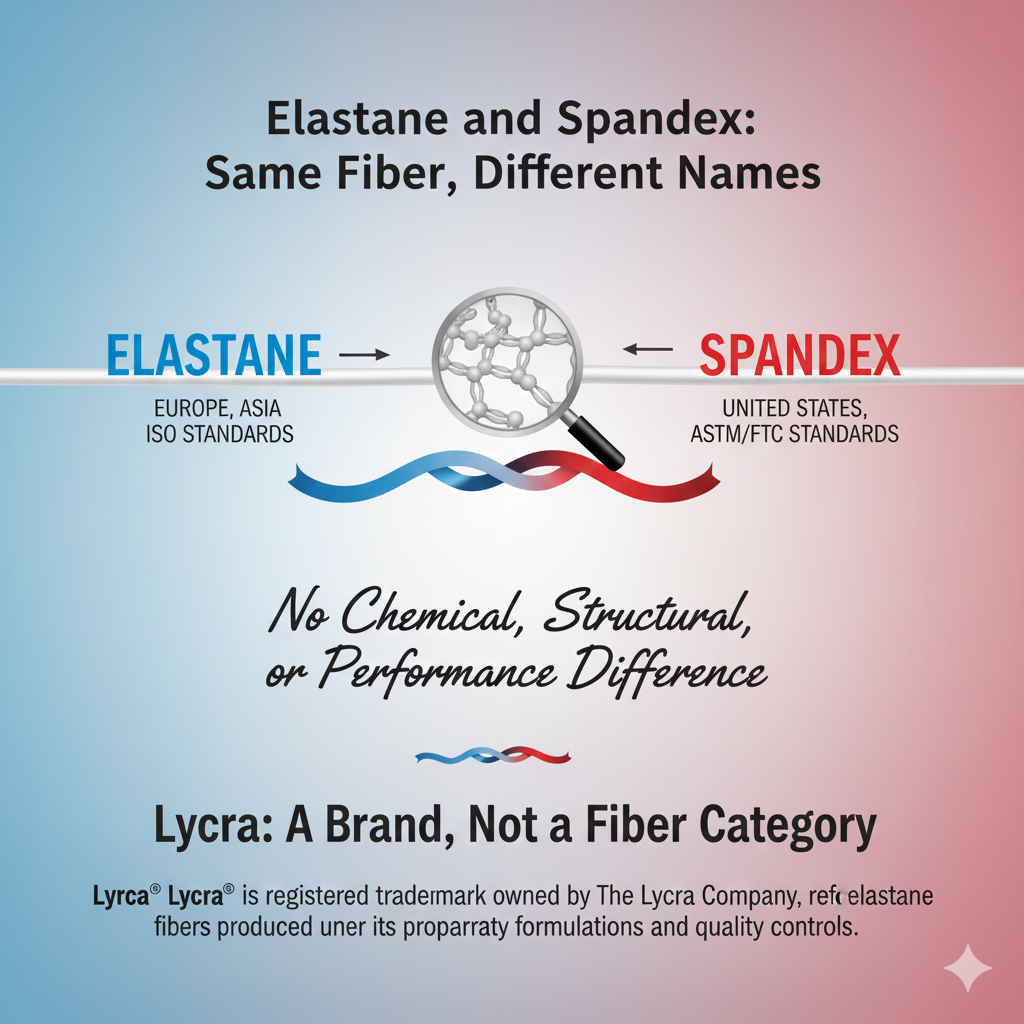
Elastane and Spandex: Same Fiber, Different Names
From a material science standpoint, elastane and spandex are the same fiber. Both refer to a segmented polyurethane-based synthetic fiber known for exceptional elasticity and recovery.
- Elastane is the internationally accepted term used in Europe, Asia, and ISO textile standards.
- Spandex is the term used primarily in the United States and follows ASTM and FTC naming conventions.
There is no chemical, structural, or performance difference between elastane and spandex. The distinction is purely linguistic and regulatory, similar to how “polyamide” and “nylon” describe the same fiber in different markets.
Lycra: A Brand, Not a Fiber Category
Lycra® is not a generic fiber name. It is a registered trademark owned by The Lycra Company, referring to elastane fibers produced under its proprietary formulations and quality controls.
Key characteristics of Lycra® include:
- Controlled polymer formulation
- Consistent filament uniformity
- Brand-backed testing, traceability, and performance guarantees
- Licensed use of the Lycra® trademark in finished garments
In simple terms: all Lycra is elastane, but not all elastane is Lycra.
Technical Comparison Overview
| Aspect | Elastane | Spandex | Lycra® |
| Fiber type | Polyurethane elastomer | Polyurethane elastomer | Polyurethane elastomer |
| Chemical structure | Identical | Identical | Identical (brand-specific formulation) |
| Terminology usage | Global / ISO | U.S. / ASTM | Trademark brand |
| Performance baseline | Varies by producer | Varies by producer | Controlled & certified |
| Brand licensing | No | No | Yes |
| Typical cost | Variable | Variable | Premium |
Performance: Where Differences Actually Appear
Performance differences do not come from the name, but from:
- Polymer formulation quality
- Filament denier consistency
- Heat and chlorine resistance
- Aging and recovery retention
- Production quality control
A high-grade non-branded elastane can outperform a low-grade elastane, regardless of whether Lycra® is used. However, Lycra® fibers are generally chosen when performance consistency, durability, and brand assurance are critical.
Conclusion
The difference between elastane, spandex, and Lycra is not a question of fiber chemistry, but of terminology, branding, and quality governance.
Elastane and spandex describe the same material; Lycra® represents a brand-specific implementation of that material with controlled standards and market recognition.
For textile professionals, the correct approach is to evaluate fiber performance data, supplier credibility, and end-use requirements, rather than relying on naming alone. Precision in terminology leads to precision in product outcomes—and fewer misunderstandings across the supply chain.
TANI THREAD CO., LTD
- Address: Thanh Hoa Hamlet, Thanh Dien Commune, Chau Thanh District, Tay Ninh Province, Vietnam
- Hotline: 0984.841.239
- Email: sale@tanithread.com
- Website: tanithread.com
- Fanpage: Tani Thread